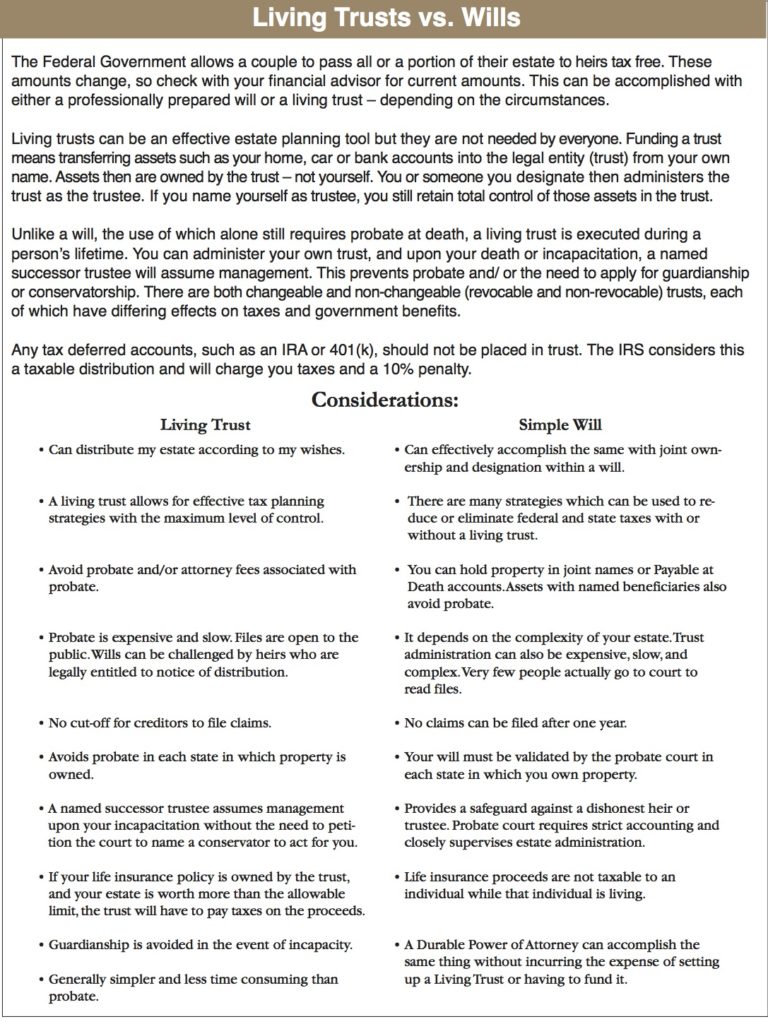


Most of us, when we die, would like to make sure our assets are distributed in the manner we would like. With that in mind, we draft a will to ensure our wishes are carried out. When you die with a will (or even without one), your estate is referred to Probate Court, which is entrusted to make sure your assets are distributed in the way you intended. Probate Courts do a great job at this, but there can be drawbacks. A will can be contested if someone feels it was written under duress or mental impairment. Courts can also be very particular, so if every penny is not accounted for the distribution of assets may not be approved. It can be a long process, and you will most likely incur attorney’s fees. It is also public record, meaning anyone can view your will and any Probate Court filings.
However, there are methods to avoid probate. The most popular involve setting up a trust (which can be costly and will involve an attorney) or dual ownership of an asset (such as a home or bank account). One often overlook tool, though, is what is referred to as a Transfer on Death (TOD) designation.
A TOD typically works in the same manner as an insurance policy, which has a named beneficiary, except the TOD is used for investment or bank accounts. Say, for instance, that you have $50,000 in an investment account. Normally, when you die, that $50,000 would be called a “Probatable Asset” meaning the $50,000 would be part of the assets that would go into probate. However, with a TOD, there is no need for probate since you already have a designated beneficiary. In this case, your assets will transfer directly to your beneficiary (or beneficiaries) instead of being tied up in Probate Court. Another advantage of a TOD is that you can easily change your beneficiary by simply filling out a new form. With a will, you will need to draft a codicil explaining your wishes, or draft an entirely new will.
While a TOD may not solve all your problems if you wish to avoid probate, this little known tool is useful to keep certain assets out of probate, giving you the ability to ensure your assets are transferred quickly to your beneficiaries.